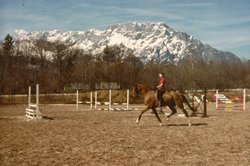
Constance in Austria in the 80’s. Medium Trot
“The Alexander Technique is one of the most valuable tools a rider can possess.”
Carl Hester, Olympic Dressage Rider
Constance Clare-Newman (above, riding in Austria, 1984) teaches dressage riders to become well-carried themselves, so that their horses have a more balanced and efficient rider.
Constance has developed a way of working that frees up deeply patterned restrictions in posture and movement.
For the student who aspires to be in true harmony with the horse, working with Constance can bridge the gap between knowing it’s possible and experiencing the reality.
Constance teaches The Well-Carried Rider workshops throughout the U.S.
Working with Constance, you will learn creative solutions based on the Alexander Technique, a mind-body method used by performing artists to better their posture and movement. This method works from the inside out. Rather than trying to hold a position, you learn principles and practices that help you ride with more suppleness, straightness and balance. You learn how to use your own back with a springy “throughness” similar to what we want in our horse’s backs. You will discover how to work both on and off the horse, recognizing habits of too much tightness or too much looseness and how to find the “just right” amount of muscle strength in ideal alignment.
You will feel a specific back-to-back connection with your horse.
You will experience a sense of ease you have never felt before.
You will understand how your everyday posture and movement can positively affect your riding and your horse’s movement.
You will acquire tools to help you continue to release ineffective habits on your own.
Balance, suppleness, coordination and rhythm are all attributes we look for in the well-schooled horse. But how often do we find them in ourselves as riders?
We have all seen riders who are beautifully poised, not interfering with the horse’s balance and movement, but rather contributing to the whole picture of fluidity and grace. Yet these riders are the exception—most of us struggle to sit securely and quietly, and to coordinate our aids with subtle precision.
In a Well-Carried Rider workshop, you practice a way of moving “through the back” that helps you coordinate an independent dressage seat. You work first on the ground, and then on the longe line. As you practice a delicate balance of the head on top of the spine (the poll!), and how to lengthen the spine, you see how this influences the quality of your posture and movement, both on and off the horse. And you experience how your everyday posture and movement influence your horse’s movement and carriage when you ride.
The principles of the Alexander Technique are fundamentally the same as those of classical equitation. Both focus on achieving integrated and supple movement, without the use of force, through the exploration of balance and connection through the whole self. The Well-Carried Rider workshops with Constance give you a chance to work on your mind-body balance and bring more efficiency and success to your riding.
Constance integrates her two decades of Alexander Technique teaching experience with continuing education on anatomy, biomechanics, neurobiology, trauma, breath coordination and improvisational practices.
With her comprehensive knowledge of classical dressage, and her training in the established German philosophy, Constance brings a clear eye and a deliberate system to a rider’s seat.
But it is her compassionate way with both horse and rider, and creative exercises and improvisations that get to the heart of teaching the dancing partners of horse and rider.